

How to Measure Windows for Blinds and Shades (Step-by-Step Guide)
Getting new blinds or shades is one of the most impactful upgrades you can make to any room. But even the most beautiful window treatment in the world will look wrong — and perform poorly — if the measurements are even slightly off. Too narrow and light pours in around the edges. Too short and the window looks incomplete. Too wide and the blind won’t fit inside the frame at all.
The good news is that measuring your windows for blinds and shades is a straightforward process once you understand the two key decisions every homeowner needs to make before picking up the tape measure. At Blinds and Shades Industry Corps, we measure and install custom window treatments for homes and businesses across South Florida every day, and this guide walks you through exactly what our professionals do — step by step.
What You Will Need Before You Start
Before measuring a single window, gather these tools:
- Steel tape measure — a steel tape measure is more accurate than a cloth tape measure, and accuracy is everything when ordering custom blinds Vista Fashion
- Pencil and notepad — to record each measurement as you go
- Step ladder — for tall or high-set windows
- Level — to ensure your measurements are straight
Be sure to measure all of your windows — whether you are moving into a home with existing windows or installing new windows yourself. Before making a purchase, record the measurements of each window separately, as window sizes may vary slightly from room to room.
Step 1: Decide Between Inside Mount and Outside Mount
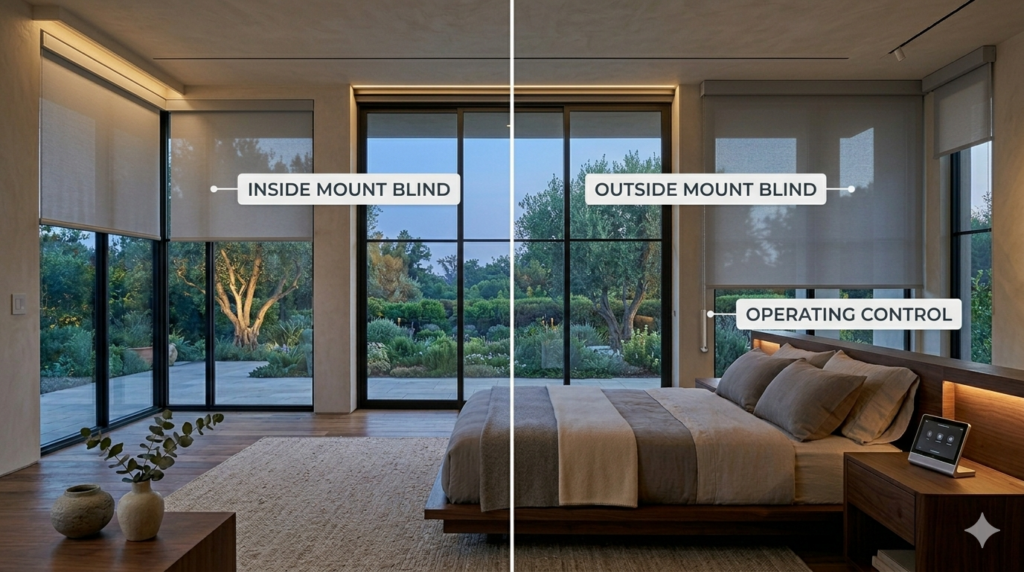
This is the single most important decision you will make before measuring, because the two mounting styles are measured completely differently and deliver different visual and functional results.
Inside Mount
Inside mount blinds sit inside the window frame. This creates a clean, built-in look that many homeowners prefer, especially with modern blinds and shades like roller shades, zebra shades, or honeycomb shades — it creates that clean, finished appearance people love.
Inside mount is the right choice when:
- Your window frame has enough depth to accommodate the headrail and brackets
- You want a minimal, streamlined look that highlights the window frame and trim
- Your windows are fairly square and even
Outside Mount
Outside mount shades and blinds are mounted outside and above the window frame on the wall surrounding it, covering much of the window to get more control over the light, and to make the windows look larger.
Outside mount is the right choice when:
- The frame is shallow or the window is noticeably out of square. It is also the go-to choice when you want stronger light control and fewer gaps — especially in bedrooms, nurseries, or media rooms. If you have a window with handles, cranks, or other obstacles, outside mount can avoid clearance issues and still look polished. Bringnox
- You want to create the illusion of a taller, larger window
- You need to cover imperfections in or around the window frame
Not sure which is right for your space? Our team at Blinds and Shades Industry Corps offers free in-home consultations where we assess every window and make the recommendation that is right for your specific situation. Book your free consultation here.
Step 2: Check Your Window Depth (Inside Mount Only)
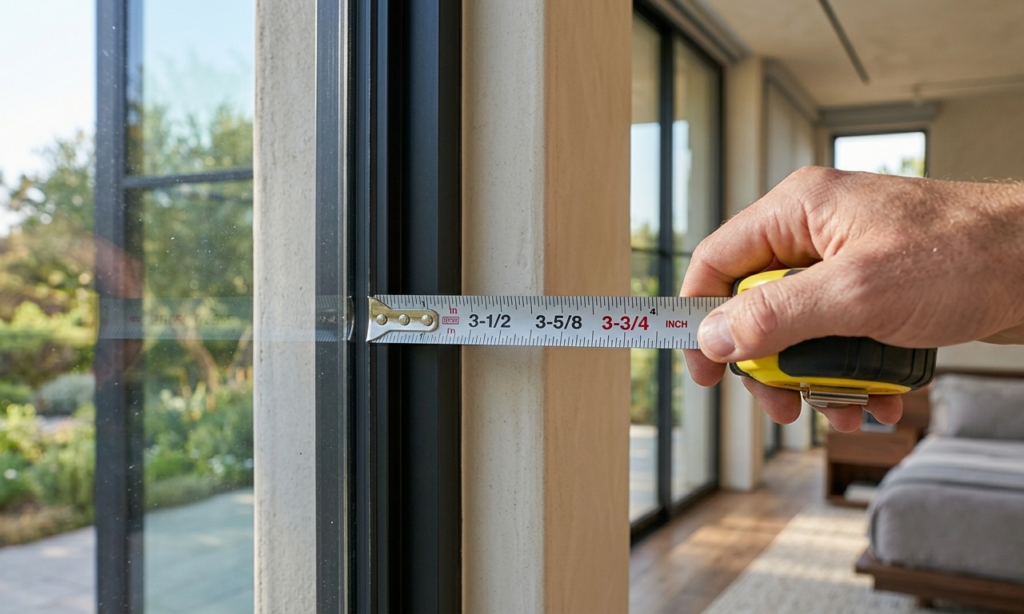
If you have decided on an inside mount, the very first thing to measure — before width or height — is the window depth. This is the distance from the glass to the outer edge of the window frame.
According to the U.S. Department of Energy, choosing the right window treatment and ensuring it fits correctly is one of the most effective ways to reduce heat gain and improve your home’s energy performance.”
The depth required will depend on the product: the vast majority of faux wood blinds require at least 2¾ inches, cellular shades require at least 2 inches, and roller shades require at least 2 inches of depth.
Here is a quick product depth reference:
| Product | Minimum Depth for Inside Mount |
| Roller Shades | 2 inches |
| Cellular Shades | 2 – 2½ inches |
| Wood Blinds | 2¾ inches |
| Roman Shades | 2 – 3 inches |
| Solar Shades | 2 inches |
If your window does not have enough depth for a true inside mount, do not force it. Outside mount is often the better option and can still look clean and professional when done correctly.
Also check for any obstructions inside the frame — window cranks, handles, locks, or alarm sensors — that could interfere with the blind’s operation when lowered.
Step 3: Measure Width and Height for Inside Mount Blinds
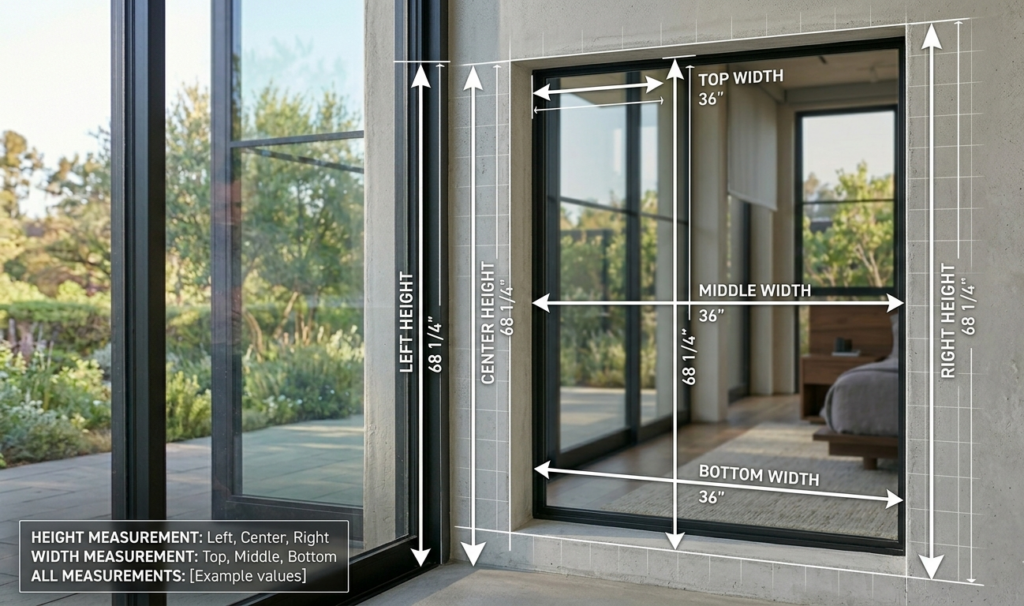
Once you have confirmed sufficient depth, you are ready to measure.
Measuring Width — Inside Mount
Measure the inside of the window frame in three places for width: across the top, middle, and bottom. This is because not all windows are built perfectly.
Record the narrowest measurement to ensure a proper fit. Do not make deductions — the factory will adjust for proper clearance when manufacturing your custom blinds.
Measuring Height — Inside Mount
Measure the height from the top inside edge of the frame to the bottom sill at the left, center, and right. Record the longest measurement. If there is no sill, measure to where you want the shade to drop.
Pro Tip: Measure to the nearest eighth of an inch. Most blinds and shades are manufactured to this degree of precision, so make sure your tape measure reads in eighth inches for the most accurate result.
Step 4: Measure Width and Height for Outside Mount Blinds
Outside mount measurements are taken differently because you are covering beyond the window frame rather than fitting within it.
Determine Your Headrail Position First
Before you take out the measuring tape, mark the headrail — the top part of your blinds, which sits outside and above the window. Make a small pencil mark where the center of your headrail should be. For most outside mount blinds, this is 2 to 4 inches above the top of the frame — the higher the mounting position, the taller the window will appear.
Measuring Width — Outside Mount
Measure the exact width you want the blind or shade to cover. Add at least 2 to 3 inches on each side — 4 to 6 inches total — to minimize light gaps and ensure full coverage.
As a practical example: outside mount blinds should extend around 3 inches over each side of the window width. So a 56-inch wide window would appropriately require a 62-inch wide blind.
Measuring Height — Outside Mount
Start from the top of where you will mount — usually just above the trim — down to the bottom of the area you want to cover. For blinds that rest on a sill, measure to the sill. For shades that extend past the sill, add 1 to 2 inches beyond for a finished look.
Check for Obstructions
Make allowances for obstructions like doorknobs, deadbolts, or moulding that might get in the way. If you have obstructions, spacer blocks or extension brackets are available to help your blind extend far enough to avoid protrusions. Always note these when placing your order.
Also confirm there is a minimum of 2 inches of flat wall or trim above the window to mount your brackets into securely.
Step 5: Measure Specialty Windows
Not every window in your home is a standard rectangle. Here is how to handle the most common specialty situations:
Bay Windows
For bay windows, each section of the bay is a separate window and must be measured individually. The widths of each panel are likely to be different — do not assume two panels are alike. Measure each one separately following the inside or outside mount steps above.
Sliding Glass Doors and Patio Doors
As most doors do not provide enough depth for inside-mounted frames, inside mount vertical blinds will not work on standard doors. For sliding patio doors, outside mount vertical blinds or outside mount roller shades are the most practical and most popular choice in South Florida homes.
Arched Windows
The minimum interior mount depth for arched windows is 1½ inches. Most shades on arched windows are bottom-mounted only, so confirm that you have a good mounting surface at the base of the arch. Arched windows are a specialty installation — contact our team directly for guidance.
Step 6: Product-Specific Measurement Tips
Different window treatments have unique measurement considerations. Here is what to keep in mind for the most popular products in our collection:
Roller Shades
For inside mount, width accuracy is critical because the shade tube sits tightly in the opening. For outside mount, add generous width on each side to prevent light gaps along the edges, especially on south- or west-facing Florida windows that receive intense afternoon sun.
Cellular Shades
Confirm minimum depth before ordering: single-cell shades need at least 2 inches of depth, and double-cell shades need at least 2½ inches minimum. Cellular shades are one of our most energy-efficient options and are especially popular in South Florida homes where heat management is a priority.
Wood Blinds and Faux Wood Blinds
Wood and faux wood blinds can require more depth because of the headrail and slat stack. Depth is the first thing to confirm before committing to inside mount. If going outside mount, make sure the blind is wide enough to cover the opening and avoid light leakage along the edges.
Roman Shades
Roman shades stack fabric when raised, so always confirm that the window depth can accommodate the folded fabric stack without pressing against the glass when fully open.
Woven Wood Shades
Natural material shades can vary slightly in their finished dimensions. Always order with the exact measurements and allow the factory to apply any necessary deductions — never pre-deduct on your end.
The Most Common Measuring Mistakes to Avoid
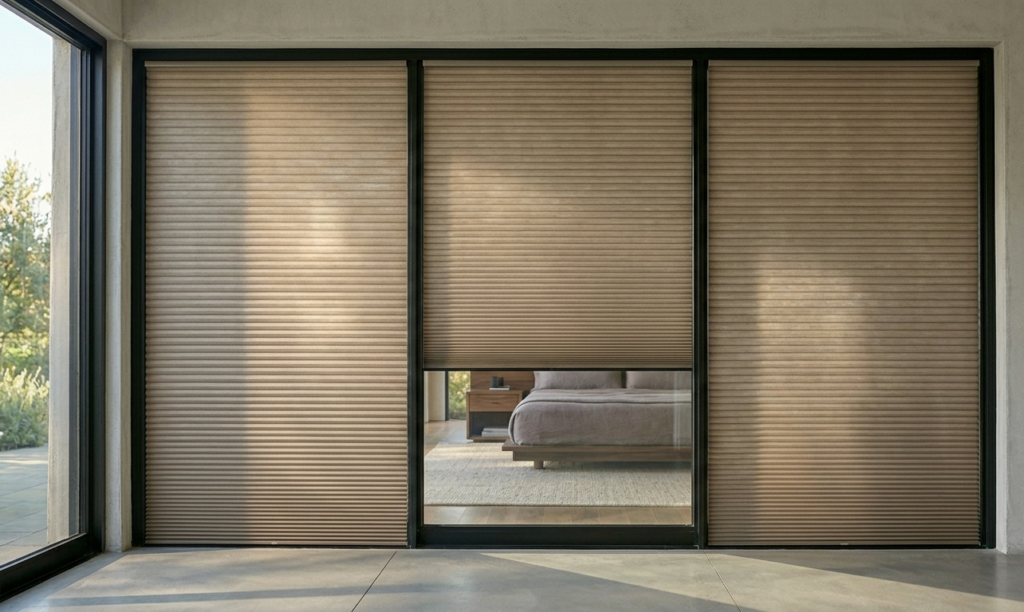
Always measure each dimension at least twice. A single misread can result in a blind that does not fit and cannot be returned once manufactured. The Window Covering Manufacturers Association (WCMA) recommends professional measurement for any custom window treatment order to guarantee a perfect fit and safe installation.
After measuring and installing hundreds of windows across South Florida, these are the mistakes our team sees most often:
Measuring the old blind instead of the window — Old blinds may have been cut down, altered, or ordered incorrectly. Always measure the window itself.
Rounding to a whole number — When measuring, use inches and fractions of an inch rather than decimals for precision. Most blinds and shades are sold and manufactured in fractions of an inch.
Measuring only once — Always measure each dimension at least twice. A single misread can result in a blind that does not fit and cannot be returned once manufactured.
Forgetting window obstructions — Cranks, handles, and locks sitting inside or near the frame must be noted before ordering inside mount treatments.
Assuming all windows are the same size — Even windows that appear identical from across the room may vary slightly in their actual dimensions. Measure every window individually before placing any order.
When to Call a Professional Instead
Measuring is absolutely something most homeowners can do themselves using this guide. But there are situations where professional measuring is the safer, smarter choice:
- Large sliding doors or floor-to-ceiling windows
- Arched, angled, or irregularly shaped windows
- Windows in high or hard-to-reach locations
- Motorized or automated shade systems where precision is critical
- Any window where you have measured multiple times and are still unsure
At Blinds and Shades Industry Corps, every custom order begins with a free professional measurement performed by our installation team. We come to your home, take precise measurements of every window, confirm the right mount type and product for each space, and handle the full installation from start to finish. There is zero guesswork on your end — and zero risk of a misfit.
Ready for a Perfect Fit — Every Time?
Getting your measurements right is the foundation of a beautiful window treatment installation. Now that you know exactly how to measure your windows, you are ready to explore the products that will bring your space to life.
Browse our full shades collection — including roller shades, solar shades, cellular shades, and Roman shades — or explore our blinds range featuring wood blinds, vertical blinds, and more.
Or skip the measuring entirely and let our team handle it all.
👉 Book your free in-home consultation today and our South Florida experts will measure every window, recommend the perfect treatment for each space, and deliver a flawless custom installation guaranteed.
Have questions about a specific window type or product? Contact our team directly and we will be happy to help.
❓ FAQ
Q: How do you measure a window for inside mount blinds?
To measure for inside mount blinds, use a steel tape measure to record the width at three points inside the frame — top, middle, and bottom — and use the narrowest measurement. Then measure the height at three points — left, center, and right — and use the longest measurement. Do not make any deductions; the factory automatically adjusts for clearance when manufacturing custom blinds.
Q: How do you measure a window for outside mount blinds?
For outside mount blinds, mark your headrail position 2 to 4 inches above the window frame. Measure the width of the area you want to cover, adding at least 2 to 3 inches on each side beyond the frame. Measure the height from your headrail mark down to the sill or desired endpoint, adding 1 to 2 inches below the sill for full coverage.
Q: How much depth does a window need for inside mount blinds?
The required depth varies by product. Roller shades and solar shades need a minimum of 2 inches. Single-cell cellular shades need at least 2 inches, and double-cell cellular shades need 2½ inches. Wood blinds and faux wood blinds typically require at least 2¾ inches of frame depth for a proper inside mount installation.
Q: Should I measure the old blind or the window when replacing blinds?
Always measure the window itself — never the old blind. Old blinds may have been cut down, incorrectly sized, or adjusted over time. Measuring the actual window frame gives you the accurate dimensions needed for a perfect custom fit.