Energy Efficient Window Shades to Lower Your Electric Bill in 2026
If your electric bill climbs every summer and you have already tried every obvious fix, there is one significant source of energy loss most homeowners overlook: their windows. Choosing the right energy efficient window shades is one of the most effective upgrades you can make — reducing the heat pouring through your glass and cutting your air conditioning costs starting from the very first month of installation. According to the U.S. Department of Energy, heat gain and heat loss through windows account for 25 to 30% of all residential heating and cooling energy use — a significant portion of your monthly electric bill quietly escaping through untreated glass.
The right energy efficient window shades can meaningfully reduce the heat pouring into your home through the glass — and in a state like Florida, where air conditioning runs almost every month of the year, that translates directly into real, recurring savings on your electric bill. According to the U.S. Department of Energy, heat gain and heat loss through windows account for 25 to 30% of all residential heating and cooling energy use. That is a significant portion of your monthly bill quietly escaping through your glass.
The good news is that the right window shade acts as a genuine thermal barrier — blocking solar heat gain in summer, retaining warmth in cooler months, and reducing the load on your air conditioning system year-round. At Blinds and Shades Industry Corps, we install energy efficient window shades for homes and businesses across South Florida every day. This guide breaks down the best options available in 2026, how each one works, and how to choose the right one for your specific home.
Why Windows Are Your Home’s Biggest Energy Weak Point
Before getting into the products, it helps to understand the science — because once you see how much energy escapes through untreated windows, the value of the right shade becomes immediately obvious.
Windows are often a weak point in a home’s energy efficiency. They tend to let heat escape during cooler months and allow solar heat gains during warmer months. Nearly 80% of U.S. homes have inefficient single or double-pane windows, yet only 2% of those homes are updated with more efficient windows each year — primarily due to high purchase and installation costs.
In cooling seasons, about 76% of sunlight that falls on standard double-pane windows enters and becomes heat inside your home. Energy efficient window shades reduce this heat gain, lower energy bills, and improve indoor comfort — which is why they are increasingly favored by homeowners across the country.
Windows lose energy in three primary ways:
Solar heat gain — Direct sunlight passing through glass heats up interior surfaces and air, forcing your air conditioner to work harder. This is the dominant energy issue in South Florida, where sun intensity is high year-round.
Conduction — Heat transfers directly through the glass itself. Single-pane windows are the worst offenders, but even double-pane glass loses heat significantly faster than an insulated wall.
Air leakage — Gaps around window frames allow conditioned air to escape and outdoor air to enter. The right window shade installed with a tight fit can reduce this effect considerably.
Energy efficient window shades address all three of these mechanisms simultaneously — which is why they deliver results that most homeowners notice immediately on their next electric bill.
The 5 Best Energy Efficient Window Shades for 2026
Shade #1: Cellular Honeycomb Shades — The Gold Standard for Energy Savings
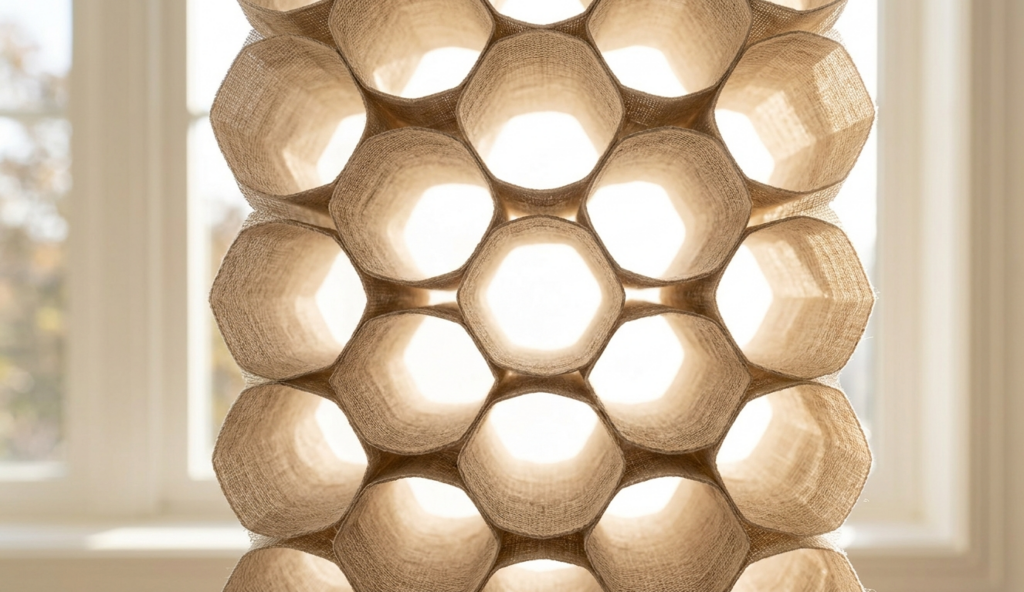
If there is one window treatment that energy professionals, government researchers, and homeowners consistently agree on as the top performer for energy efficiency, it is cellular honeycomb shades. And the research behind this consensus is compelling.
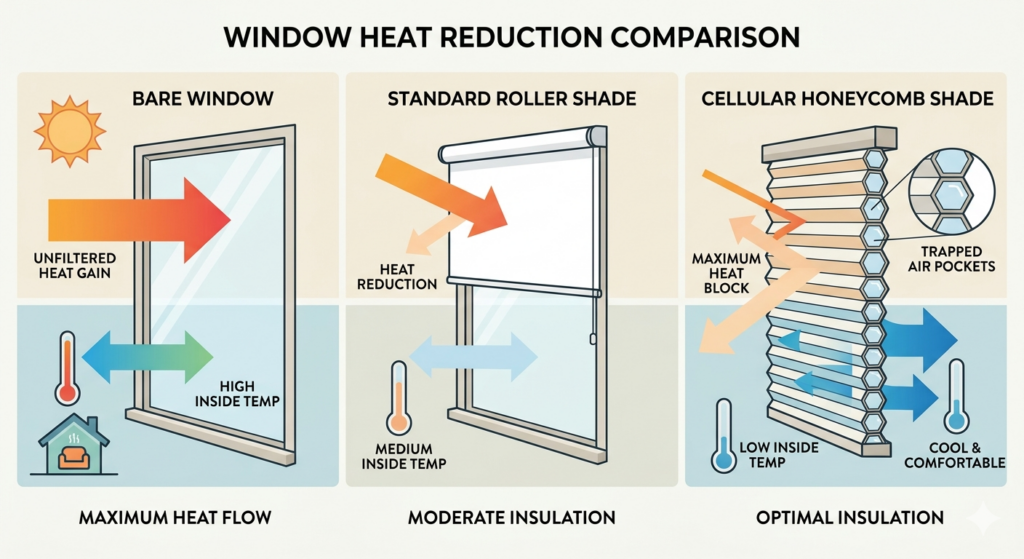
In heating seasons, tightly installed cellular shades can reduce heat loss through windows by 40% or more, which equates to about 10% heating energy savings. In cooling seasons, cellular shades can reduce unwanted solar heat through windows by up to 60%, reducing the total solar gain to 20% when installed with a tight fit.
Research from the Oak Ridge National Laboratory (ORNL) confirms these numbers in real-world residential testing. Experimental testing of cellular shades showed daily heating energy savings in the range of 17 to 36% compared to windows with no shading device. Total site energy savings for heating and cooling from cellular shades reached up to 15% for homes with gas furnaces and 9% for homes with heat pumps. WifiTalents
How do they achieve this? Honeycomb blinds are engineered to improve your home’s R-value — a measure of thermal resistance. Unlike standard roller shades that are a single flat sheet, the air pockets in cellular shades act as an insulator, preventing heat from escaping during winter and blocking solar heat gain during summer.
Cell configuration matters significantly:
| Configuration | Best For | Energy Performance |
| Single-cell | Mild climates, cost-conscious buyers | Good insulation baseline |
| Double-cell | Most Florida homes — heat and humidity | Superior insulation — recommended |
| Triple-cell | Maximum thermal performance | Highest R-value available |
Cellular shades that operate on side tracks are most effective at increasing the R-value of windows, and those that open from both the top and bottom allow users to most effectively control daylight entering the home.
ENERGY STAR certified cellular shades meet strict energy performance standards set by the U.S. Environmental Protection Agency, making them eligible for potential federal tax credits under the Inflation Reduction Act — up to 30% of product cost for qualifying installations.
Our cellular shades are custom-made for your exact window dimensions, ensuring the tight fit that is essential for maximum energy performance. A poorly fitted cellular shade leaves gaps that allow heat to bypass the insulating cells entirely.
Shade #2: Solar Shades — The Florida Homeowner’s Best Friend
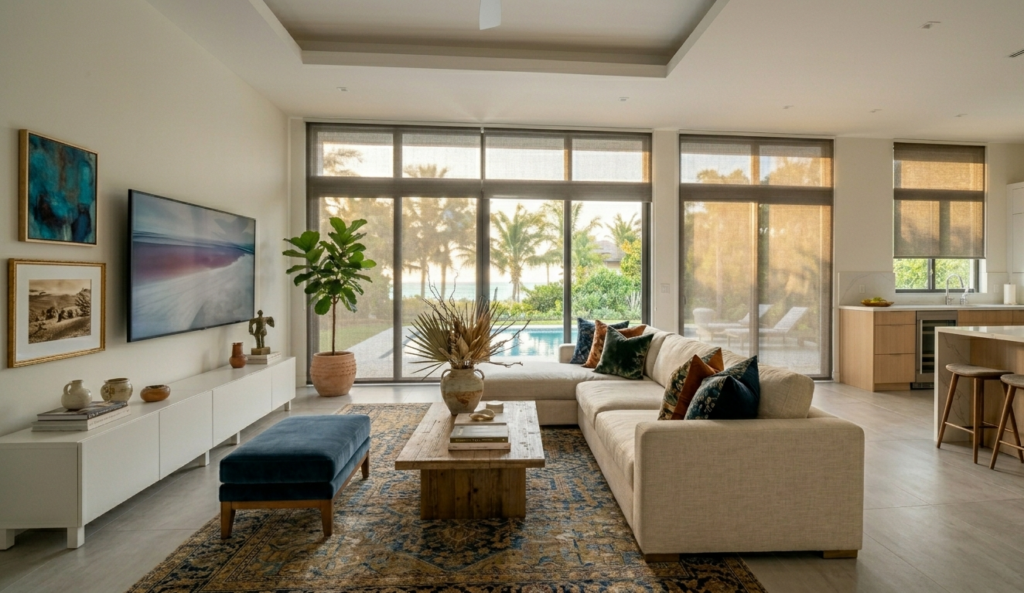
While cellular shades lead in overall insulation performance, solar shades are arguably the most practical and popular choice specifically for South Florida homes — and with excellent reason.
A quality roller shade with a reflective backing can block 60 to 80% of incoming solar heat, keeping rooms noticeably cooler without cranking the air conditioning. Window shades reduce energy consumption through solar heat gain reduction — during summer, sunlight streaming through windows heats up interior spaces, forcing your air conditioner to work harder. The right shade intercepts that process before it starts.
Solar shades are uniquely designed to block heat and UV rays while still preserving your view — making them the ideal choice for living rooms, home offices, and dining areas where you want natural light and an outdoor view but cannot afford the heat that comes with bare glass.
Key performance metrics for solar shades:
- Openness factor — The lower the openness percentage, the more heat and glare is blocked. A 3% openness fabric blocks significantly more solar heat than a 10% openness fabric
- UV protection — Quality solar shades block up to 99% of harmful UV rays, protecting furniture, flooring, and artwork from fading
- Glare reduction — Eliminates the harsh afternoon glare that makes south and west-facing rooms uncomfortable
For Florida homeowners with large windows or sliding glass doors facing south or west — where afternoon sun is most intense — solar shades are one of the fastest-payback energy investments available.
Shade #3: Blackout Roller Shades — Maximum Heat Blocking for Bedrooms
Motorized blackout roller shades are convenient, energy efficient — delivering up to 20% savings on cooling costs — and smart home capable, making them a top choice for modern Florida homes in 2026.
Blackout roller shades use dense, tightly woven or coated fabrics that block virtually all light and a significant portion of solar heat gain. For bedrooms — especially in Florida where east-facing windows receive intense morning sun — blackout roller shades deliver both superior sleep quality and meaningful energy performance.
Quality blackout roller shade fabrics can block up to 99% of incoming light and reduce solar heat gain by 75 to 85% on south and west-facing windows during peak sun hours.
For maximum energy performance, pair blackout roller shades with cellular shades or custom drapery — the layered combination delivers both the light blocking of the blackout fabric and the insulating air pocket of the cellular structure simultaneously.
Shade #4: Roman Shades with Thermal Lining — Elegance Meets Energy Performance
Roman shades are one of the most beautiful window treatments available — and when ordered with a thermal or blackout lining, they become a genuinely strong energy performer as well.
The lining adds a dense insulating layer behind the decorative face fabric that blocks solar heat gain, reduces light penetration, and creates an additional barrier between the window glass and the room. Thermal-lined Roman shades are particularly effective in living rooms, dining rooms, and master bedrooms where both aesthetics and energy performance are priorities.
During the cooler seasons, window shades serve as an additional insulation barrier, preventing warm air from escaping through the glass surfaces — extending their energy benefit well beyond just the Florida summer cooling season.
For homeowners who want a refined, tailored look that does not compromise on energy performance, thermally lined Roman shades are one of our most recommended solutions.
Shade #5: Woven Wood and Natural Shades — Eco-Friendly Energy Savings
Woven wood shades crafted from bamboo, reeds, and natural grasses offer a different kind of energy benefit — one that comes from their natural thermal mass and dense woven structure rather than engineered insulation.
The shift toward sustainable and eco-friendly materials in window coverings is one of the dominant market trends of 2026, driven by environmental consciousness and growing demand for natural, organic home interiors.
While woven wood shades are not the highest performers in pure insulation metrics, they excel at diffusing direct sunlight — reducing glare and solar heat gain while allowing soft, warm light to filter through. Paired with sheer curtains or cellular shades as a layered treatment, they deliver both natural beauty and meaningful energy performance.
Energy Savings Comparison — At a Glance
| Window Shade Type | Heat Reduction | Best Room | Energy Savings Potential |
| Cellular Honeycomb | Up to 60% cooling / 40% heating | Whole home | Highest — 10–15% total energy |
| Solar Shades | 60–80% solar heat blocked | Living room, office, dining | High — ideal for sun-facing windows |
| Blackout Roller Shades | Up to 85% on south/west windows | Bedroom, media room | High — strongest for cooling |
| Thermal Roman Shades | Moderate to high | Living room, bedroom | Medium-high — enhanced with lining |
| Woven Wood Shades | Light diffusion and glare control | Living room, dining room | Medium — best when layered |
Florida-Specific Tips: Maximising Energy Savings in South Florida
South Florida presents unique energy challenges that homeowners in cooler states do not face to the same degree. Here is how to get the most energy savings from your window treatments specifically in the Hollywood, Miami, and surrounding areas:
Prioritise south and west-facing windows first — These receive the most direct afternoon sun and are responsible for the largest share of your home’s solar heat gain. Installing energy efficient window shades on these windows first delivers the fastest payback on your investment.
Choose lighter exterior-facing fabrics — Lighter coloured shade fabrics reflect more solar radiation before it enters your home. For solar shades and roller shades on sun-facing windows, a white or light grey exterior-facing fabric outperforms darker colours in heat reflection.
Use automation for maximum performance — To truly maximise energy savings, consider automation. Motorized shades can be scheduled to close during the hottest part of the day, keeping your home cool even when you are not there to manually adjust them. For Florida homeowners who leave for work in the morning and return in the evening, automated shades that close during peak afternoon hours can dramatically reduce the cooling load that builds up while the home is unoccupied.
Layer treatments on large windows — Large sliding glass doors and floor-to-ceiling windows are the single biggest source of solar heat gain in most South Florida homes. Combining solar shades with vertical blinds or custom drapery on these openings creates a layered thermal barrier that single treatments cannot match.
Are There Tax Credits Available for Energy Efficient Window Shades in 2026?
The Inflation Reduction Act extended and expanded federal tax credits for energy-efficient home improvements through 2032. Qualifying window treatments — specifically ENERGY STAR-certified and AERC-rated window attachments — may be eligible for a tax credit of up to 30% of the product cost, with a maximum of $600 per year.
This makes 2026 an excellent time to invest in energy efficient window shades — particularly cellular shades and ENERGY STAR certified treatments — as the tax credit can meaningfully offset the upfront cost and accelerate your payback timeline.
Ask our team about ENERGY STAR certified options when you book your free consultation — we will ensure you select products that qualify for available credits.
How Much Can You Actually Save?
The honest answer is: it depends on your home, your windows, and which shades you choose. But the data gives us a strong baseline.
Energy efficient window shades can reduce heating and cooling costs by up to 25%, and the right shade types deliver some of the best return on investment of any home improvement available at their price point.
For a typical South Florida home spending $250 per month on electricity — with a significant portion going to air conditioning — even a 15% reduction in cooling costs represents $375 to $450 in annual savings. Over the lifespan of a quality window shade installation, that adds up to thousands of dollars returned directly to your pocket.
Over a ten-year period, energy savings from the right window shades alone can reach $5,000 — making the investment one of the strongest long-term returns available in home improvement.
Ready to Lower Your Electric Bill Starting This Month?
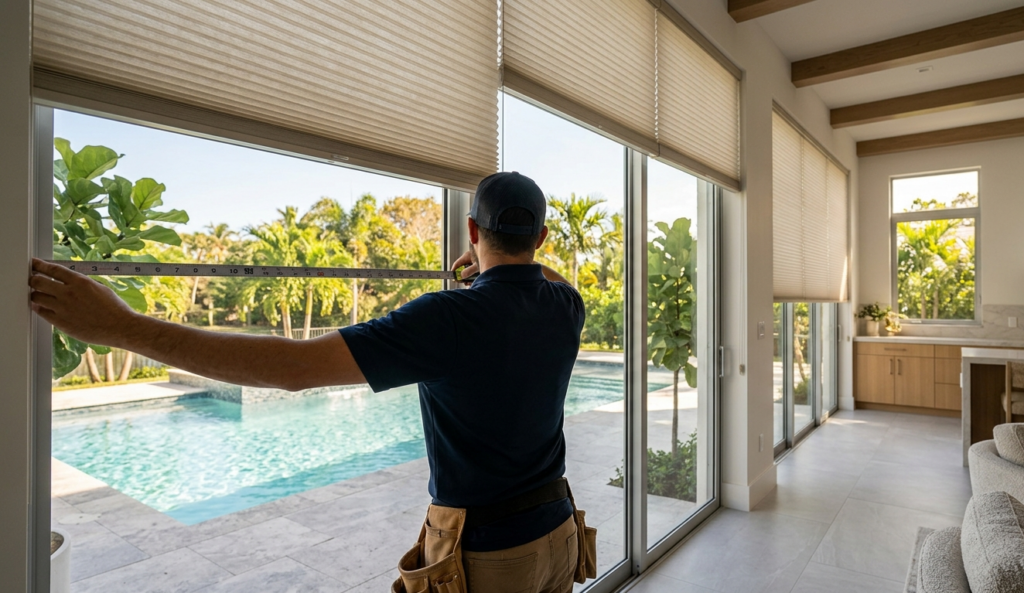
The most effective step you can take today is getting the right energy efficient window shades professionally measured and installed on your home’s highest-heat windows. Our team at Blinds and Shades Industry Corps will assess every window in your home, identify where you are losing the most energy, and recommend the exact shades that will deliver the fastest and strongest return for your specific situation.
Browse our full shades collection — including cellular shades, solar shades, roller shades, and Roman shades — or take the first step toward lower energy bills today.
👉 Book your free in-home consultation and let our South Florida window treatment specialists help you choose the right energy efficient window shades for your home — custom measured, professionally installed, and built to deliver real savings from day one.
Questions about a specific product or window? Contact our team directly and we will be happy to help.
FAQ
Q: What are the most energy efficient window shades?
Cellular honeycomb shades are the most energy efficient window shades available in 2026. According to the U.S. Department of Energy, tightly fitted cellular shades can reduce heat loss through windows by 40% or more in heating seasons and reduce solar heat gain by up to 60% in cooling seasons. Double-cell and triple-cell configurations deliver the highest R-values and the strongest energy savings.
Q: Do window shades really lower your electric bill?
Yes. Energy efficient window shades can reduce heating and cooling costs by up to 25% depending on the product, installation quality, and climate. In South Florida homes where air conditioning runs year-round, the right window shades — particularly cellular and solar shades on south and west-facing windows — can deliver hundreds of dollars in annual savings.
Q: What is the best window shade for hot climates like Florida?
For hot climates like South Florida, solar shades and cellular honeycomb shades are the top two choices. Solar shades block 60 to 80% of solar heat gain while preserving your view — ideal for living areas and offices. Cellular shades provide the strongest overall insulation and are best for bedrooms and rooms where full light control is also needed.
Q: Are energy efficient window shades eligible for tax credits in 2026?
Yes. Under the Inflation Reduction Act, ENERGY STAR certified and AERC-rated window attachments — including qualifying cellular shades — may be eligible for a federal tax credit of up to 30% of the product cost, with a maximum of $600 per year through 2032. Consult a tax professional to confirm eligibility for your specific installation.
Q: What is R-value in window shades?
R-value measures a material’s thermal resistance — how effectively it slows heat transfer. The higher the R-value, the better the shade performs as an insulator. A standard double-pane window has an R-value of approximately 1.8. Adding double-cell cellular shades increases the combined R-value significantly, creating a much stronger thermal barrier between the glass and your living space.