

Choosing new window treatments always comes down to the same fundamental question for most homeowners: roller shades vs curtains — which one is actually the better choice for your space? Both are popular, both are proven, and both come in enough styles and fabrics to work in virtually any room. But they are genuinely different products that excel in different situations — and choosing the wrong one for a specific room can mean years of frustration with a window treatment that looks great in theory but does not work the way you need it to in daily life.
At Blinds and Shades Industry Corps, we help homeowners and businesses across South Florida navigate this exact decision every day. The honest answer is that neither option is universally better than the other — the right choice depends entirely on the room, the window, your lifestyle, and what you need your window treatment to actually do. This guide breaks the comparison down category by category so you can make a confident, informed decision for every window in your home.
What Are Roller Shades?
Roller shades are a single panel of fabric that rolls up and down around a tube mounted at the top of the window. They sit flat against the glass when closed, roll completely out of sight when open, and are available in a wide spectrum of fabrics — from sheer and light filtering to full blackout — that control exactly how much light and heat enters the room.
Curtains bring warmth and softness into a space like no other window treatment can. They come in a variety of styles — sheer for light filtering or blackout for privacy and darkness at night — allowing you to control not only the aesthetics but also the mood in the room. The versatility curtains offer in terms of color, fabric type, pattern, and length is vast. Floor-length drapes create drama, while shorter lengths provide casual, relaxed vibes.
Our custom drapery and sheer curtains collections are made to your exact measurements and specifications — because ready-made curtains almost never hang correctly on non-standard windows, which is the majority of South Florida homes.
Roller Shades vs Curtains: Round-by-Round Comparison
Round 1: Light Control
Winner: Roller Shades
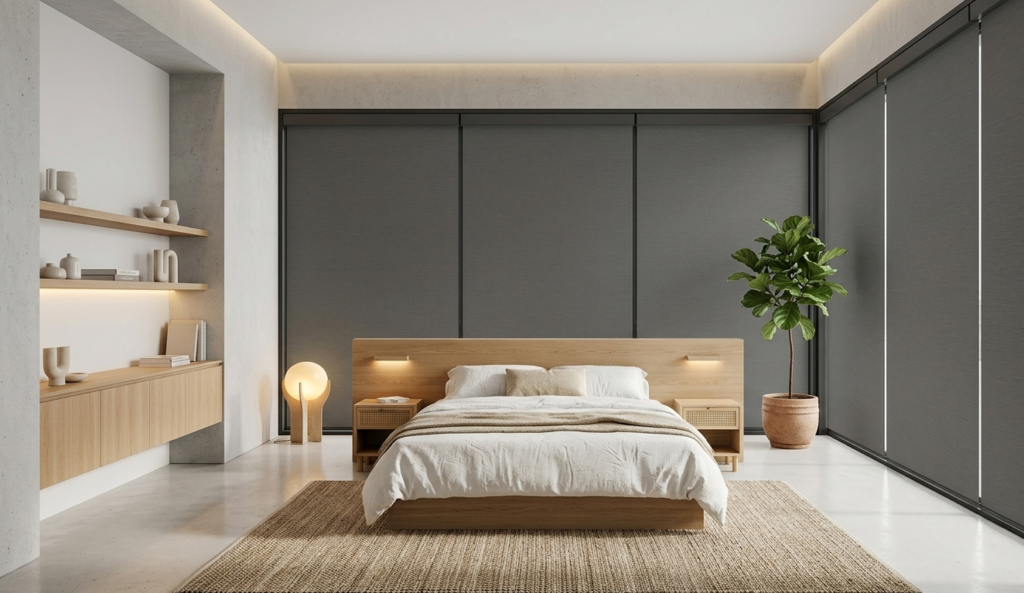
Both options provide solid daytime privacy. Roller shades in light-filtering fabric obscure the view from outside while still letting light through. Blackout roller shades provide complete privacy at any hour. Curtains offer strong privacy when fully drawn, particularly heavier fabrics with liners. Sheer curtain panels on their own reduce visibility from outside during the day, but can allow silhouettes to show at night when interior lights are on.
The edge goes to roller shades because they allow true precision — you control exactly how far down the shade sits, meaning you can dial in the exact amount of light you want with consistent, repeatable accuracy. Curtains are either open or closed — there is no in-between position that does not involve the panel bunching awkwardly against the frame.
For rooms where precise light control matters most — home offices, media rooms, bedrooms — roller shades are the stronger performer.
Round 2: Privacy
Winner: Tie — depends on fabric and time of day
During daylight hours, both roller shades and curtains provide effective privacy when correctly specified. At night, the equation shifts. For the strongest nighttime privacy, blackout roller shades or lined curtain panels are the most effective solution — sheer curtains alone allow interior silhouettes to show when interior lights are on after dark.
The key takeaway: if nighttime privacy is a priority — in ground-floor bedrooms, street-facing living rooms, or bathroom windows — choose blackout roller shades or fully lined curtain panels. Solar shades are excellent for daytime glare control but do not provide nighttime privacy on their own and should be layered with a secondary treatment for full around-the-clock coverage.
Round 3: Style and Aesthetics
Winner: Curtains — for traditional and transitional spaces. Roller shades — for modern and minimalist spaces.
This is where personal taste and interior design style matter most, and where neither option is objectively superior.
Roller shades offer a clean, modern look with easy operation. Curtains bring a traditional charm while offering versatility in style, from pinch pleats to grommet tops. To illustrate the comparison — imagine your window as an art canvas. Roller shades are like bold, abstract strokes — clean, precise, and contemporary. Curtains are like detailed oil paintings full of texture and depth. Both have unique aesthetic merits. It ultimately depends on the style that suits your home best.
For South Florida homes with modern, coastal, or minimalist interiors — which describes the majority of new construction and renovated homes in the Hollywood, Miami, and Fort Lauderdale areas — roller shades almost always deliver a cleaner, more architecturally integrated result.
For homes with traditional, transitional, or maximalist interiors — where warmth, layering, and textile richness are design priorities — custom drapery and curtains are often the more natural fit.
Our woven wood shades offer an interesting middle ground — the clean operation of a shade with the warmth and natural texture of a woven fabric — and are one of our most popular choices for coastal Florida interiors that want both modern functionality and organic warmth.

Round 4: Energy Efficiency
Winner: Cellular Shades — but roller shades edge curtains in most Florida scenarios
According to the U.S. Department of Energy, windows account for 25 to 30% of all residential heating and cooling energy use. In South Florida, where air conditioning runs year-round, this makes energy performance one of the most important criteria for any window treatment decision.
Blackout curtains provide added insulation and noise reduction due to their thick fabric. Roller shades, on the other hand, are sleek, modern, and easy to maintain, offering a more minimalist approach to light control.
For pure insulation, cellular shades outperform both roller shades and curtains — their honeycomb air-pocket structure delivers the highest thermal resistance of any fabric window treatment. But comparing roller shades directly to curtains in Florida’s climate, roller shades — particularly solar shades — win on solar heat gain reduction. Their flat profile fits tightly against the window frame, reducing the air gap between the glass and the room and leaving fewer pathways for heat to enter.
Thermal-backed curtains can provide good insulation, but the average life expectancy of curtains ranges from 3 years for sheers to 5 years for lined curtains — meaning the energy benefit degrades faster as the fabric wears.
Round 5: Maintenance and Durability
Winner: Roller Shades
This is one of the most practically important categories for busy South Florida households — and roller shades win convincingly.
Roller shades are designed with durability in mind. Made from robust materials like vinyl or fabric, they are built to withstand daily use without fraying or tearing. Cleaning is straightforward — just wipe them down with a damp cloth. They do not collect dust as easily as curtains do, making them an ideal choice for allergy sufferers.
A good set of roller shades can last up to 10 years or more with proper care, while curtains may need changing every five to seven years due to their susceptibility to sun damage and the more demanding cleaning process they require.
In Florida’s humid, high-UV environment specifically, this durability gap is even more pronounced. Quality fabric roller shades can last 5 to 8 years in Florida, and longer in lower-sun rooms. Curtains — particularly sheers — are more vulnerable to UV degradation and humidity-related fabric breakdown in the South Florida climate.
For households with children, pets, or high-traffic rooms, the wipe-clean, hard-wearing nature of roller shades makes them the significantly more practical long-term choice.
Round 6: Cost
Winner: Depends on specification — roller shades win on long-term value
According to Angi’s 2026 Window Treatment Cost Guide: window treatment costs average $167 to $1,874, with most homeowners paying an average of $1,021 for a full installation. Prices can range from $55 for basic options to over $5,000 for custom drapes or automated shades.
For a more specific comparison: roller shades cost $100 to $350 per window for quality options. The average cost of blackout curtains ranges from $20 to $50 per panel for standard sizes, with premium or custom options costing upwards of $100 per panel.
The critical word there is panel — a standard window typically requires two curtain panels plus a rod, rings, and hardware, which brings the true per-window cost of curtains considerably closer to — and often past — the cost of a quality roller shade. Factor in that curtains need replacing more frequently and the long-term cost advantage shifts clearly in favour of roller shades.
Round 7: Smart Home Compatibility
Winner: Roller Shades
Many roller shades offer automation including sun sensors and timers, while curtains can be drawn manually or with tiebacks and pulleys.
Motorized roller shades integrate seamlessly with Amazon Alexa, Google Home, and Apple HomeKit, enabling voice control, app scheduling, and full smart home automation. While motorized curtain track systems do exist, they are significantly more expensive, less widely available, and more complex to install than motorized roller shade systems.
For any homeowner building out a smart home ecosystem in 2026, roller shades are the clear, practical choice for window automation.
The Best of Both Worlds: Layering Roller Shades and Curtains
Here is the insight that changes the conversation for many homeowners: you do not always have to choose one over the other.
Both styles can be layered for added insulation or decorative flair. Roller shades work beautifully behind sheer curtains for softness without bulk — the sheer panels add warmth and texture to the window while the roller shade handles light control and privacy with precision.
Layering is one of the dominant window treatment trends in 2026 and is particularly effective in South Florida living rooms and master bedrooms — spaces where you want both the clean functionality of a shade and the design richness of a fabric panel. Popular layering combinations include:
- Light filtering roller shades + linen drapery panels — the most popular combination in contemporary South Florida homes
- Solar shades + sheer curtains — maximum glare control with soft, diffused light
- Blackout roller shades + custom drapery — total darkness when needed, full elegance when open
Room-by-Room Recommendation Guide
| Room | Best Choice | Why |
| Bedroom | Blackout roller shades | Precise light control, easy operation, cord-free safety |
| Living room | Layered — roller shades + drapery | Best of both worlds — function and design |
| Home office | Solar shades | Glare control with preserved view and natural light |
| Kitchen | Roller shades | Wipe-clean, moisture resistant, space efficient |
| Bathroom | Roller Shades | Humidity resistant, privacy, minimal footprint |
| Dinning room | Curtains or Roman shades | Warmth, texture, and elegant design statement |
| Children’s bedroom | Cordless blackout roller shades | Child-safe, blackout performance, easy to clean |
| Sliding glass door | Vertical blinds or roller shades | Coverage for wide openings, smooth operation |
So Which Should You Choose?
Neither roller shades nor curtains are universally better. Roller shades win on maintenance, space efficiency, and modern aesthetics. Curtains win on warmth, texture, and design versatility. The best choice depends on the room, the look you want, and how much daily effort you are willing to put into your window treatments.
For most South Florida homes in 2026 — with their modern architecture, intense sun exposure, humidity, and growing smart home adoption — roller shades are the stronger everyday performer. But for living rooms, dining rooms, and master bedrooms where design warmth and layering are priorities, custom drapery and curtain panels remain an irreplaceable design element.
The smartest approach for most homes is not to choose one over the other — it is to use each one where it genuinely excels, and layer them together where the room calls for both.
Not Sure Which Is Right for Your Windows?
Our team at Blinds and Shades Industry Corps will come to your home, assess every window, and give you an honest recommendation for each space — whether that is a roller shade, curtains, a layered combination, or something else entirely from our full collection.
Browse our full shades collection including roller shades, solar shades, Roman shades, and cellular shades, or explore our custom drapery and sheer curtains collections.
👉 Book your free in-home consultation today and let our South Florida window treatment specialists help you find the perfect solution for every room in your home — custom measured, professionally installed, and guaranteed to look great from day one.
Have questions about a specific room or window? Contact our team directly and we will be happy to help.
FAQ
Q: Are roller shades better than curtains?
Neither roller shades nor curtains are universally better — the right choice depends on the room and your priorities. Roller shades win on light control precision, maintenance, durability, smart home compatibility, and modern aesthetics. Curtains win on design warmth, texture, and versatility. For most modern South Florida homes, roller shades are the stronger everyday performer, while curtains excel as a layered design element in living rooms and dining rooms.
Q: Do roller shades provide enough privacy?
Yes. Light-filtering roller shades provide strong daytime privacy by obscuring the view from outside while still allowing diffused light through. Blackout roller shades provide complete privacy at any hour. For nighttime privacy, blackout roller shades are more effective than sheer curtain panels, which can allow silhouettes to show when interior lights are on after dark.
Q: How long do roller shades last compared to curtains?
Quality roller shades typically last 8 to 10 years with proper care. Curtains have a shorter average lifespan — approximately 3 years for sheer panels and 5 to 7 years for lined curtains — due to greater susceptibility to sun damage, fabric wear, and the demands of regular washing. In Florida’s high-UV environment, this durability gap is even more pronounced.
Q: Can you use roller shades and curtains together?
Yes — and this is one of the most popular window treatment approaches in 2026. Layering roller shades with curtain panels gives you the precision light control and clean lines of the shade combined with the warmth, texture, and design richness of fabric drapery. Popular combinations include light-filtering roller shades with linen drapery panels, and solar shades paired with sheer curtains.
Q: Are roller shades good for Florida homes?
Yes. Roller shades — particularly solar shades and blackout roller shades — are an excellent choice for Florida homes. Solar shades block 60 to 80% of incoming solar heat, reducing air conditioning demand significantly. Roller shade fabrics are also resistant to humidity and easy to clean, making them well-suited to Florida’s warm, humid climate. Custom-fitted roller shades from a local South Florida specialist ensure the tight fit that maximises both energy performance and appearance.